


Understanding how to choose LLC name ideas means balancing a memorable bran...

 Blogs
 Filters
Back to Blogs

Why Your Small Business Needs a Telephone Answering Service
Operations
Sep 29, 2026
9 min
Running a small business often means switching between customers, sales, admin, meetings and day-to-day operations. When the phone rings in the middle of all that, answering every call can quickly become difficult.
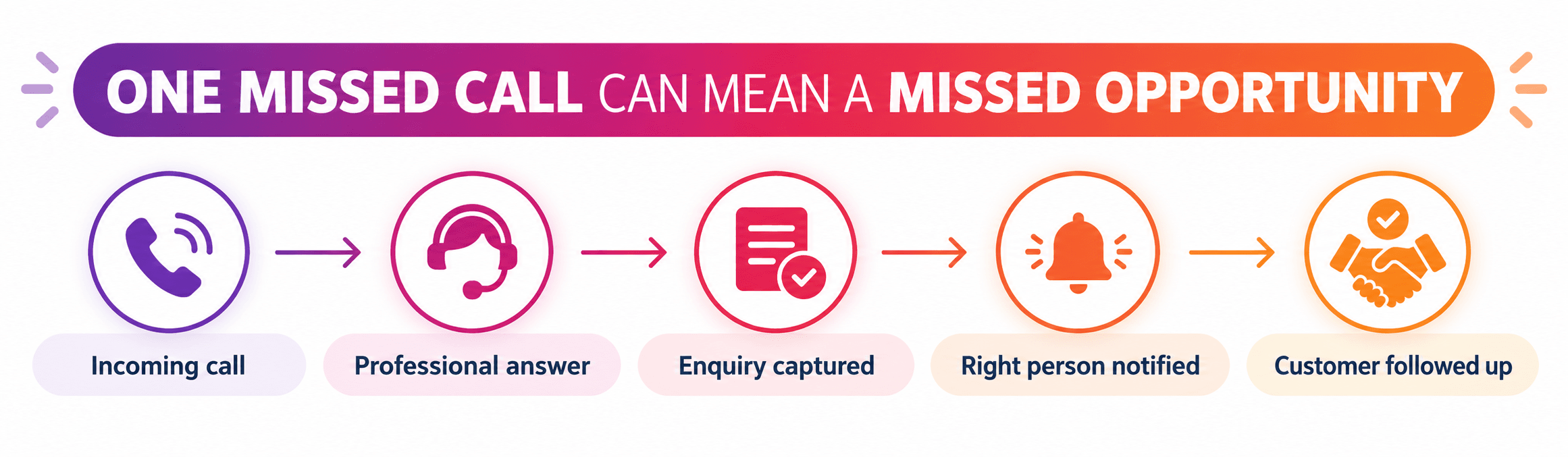
The problem is that an unanswered call is not always just a missed conversation. It could be a potential customer asking for a quote, an existing client needing help or a valuable enquiry generated through your marketing.
A telephone answering service gives small businesses a way to handle incoming calls professionally without employing a full-time receptionist. Calls can be answered in your company name, messages can be taken and important enquiries can be passed to the right person.
For small teams, freelancers and growing companies, it can provide a useful balance between remaining available to customers and having enough uninterrupted time to run the business.
What is a telephone answering service?
A telephone answering service is an outsourced service that answers incoming business calls on your behalf.
Instead of callers reaching voicemail when you are unavailable, a receptionist answers according to instructions agreed with your business.
Depending on the provider and package, the service may include:
Answering calls using your company name
Taking and forwarding messages
Collecting contact information
Transferring selected calls
Handling common customer enquiries
Qualifying potential leads
Booking appointments
Managing overflow calls
Providing evening or out-of-hours cover
This can give callers the experience of contacting an organised business reception team even when the company itself has only a few employees.
For founders using business tools to streamline different areas of their operations, telephone answering can become another practical way to reduce routine administrative work.
Missed calls can cost more than you think
Small businesses invest considerable effort in attracting customers.
You might spend money on Google Ads, search engine optimisation, social media, networking or referrals. When those activities generate a phone enquiry, the business needs a reliable way to capture it.
Consider a customer looking for an accountant, consultant, tradesperson or local service provider. They find three companies and start calling.
The first does not answer.
Rather than leaving a voicemail, they call the second.
This does not mean every missed call results in lost revenue, but businesses that regularly depend on telephone enquiries risk losing opportunities when customers cannot reach them.
A telephone answering service helps close that gap. Even when you cannot personally deal with an enquiry immediately, someone can collect the caller's details and reason for calling so your team can respond appropriately.
Professional call handling creates a stronger first impression
For a new customer, a phone call may be their first direct interaction with your business.
Compare reaching an unanswered line or generic voicemail with hearing:
“Good morning, ABC Consulting. How can I help?”
The second experience can make a small business appear more accessible and organised.
This is particularly useful for:
Consultants
Freelancers
Tradespeople
Contractors
Startups
Agencies
Professional service firms
Home-based businesses
Professional call handling does not require a large office or an internal reception department.
A virtual receptionist can provide consistency while you work from home, visit customers, attend meetings or manage a distributed team.
This can also complement other decisions made while setting up a business. Entrepreneurs who are still deciding on their legal structure can review Start My Business company formation services as part of building the wider foundations of their company.
Protect your time without ignoring customers
Answering a phone call takes more time than the conversation itself.
Imagine you are preparing a proposal.
The phone rings, so you stop working. You answer the enquiry, take down the caller's details, send a follow-up email and then try to remember where you were.
Ten minutes later, another call arrives.
Repeated interruptions can make focused work difficult, particularly when the founder is responsible for both delivering the service and managing the business.
An answering service allows you to decide which calls need immediate attention.
Urgent enquiries can potentially be transferred, while routine calls can be recorded for later follow-up.
This creates a simple system:
Routine call → Message taken → Follow up later
Urgent call → Identified → Transferred or escalated
Rather than answering every call automatically, you can focus your attention where it has the greatest value.
Get reception support without hiring too early
A growing company may eventually need an in-house receptionist, but employing someone solely to answer calls is not always practical during the early stages.
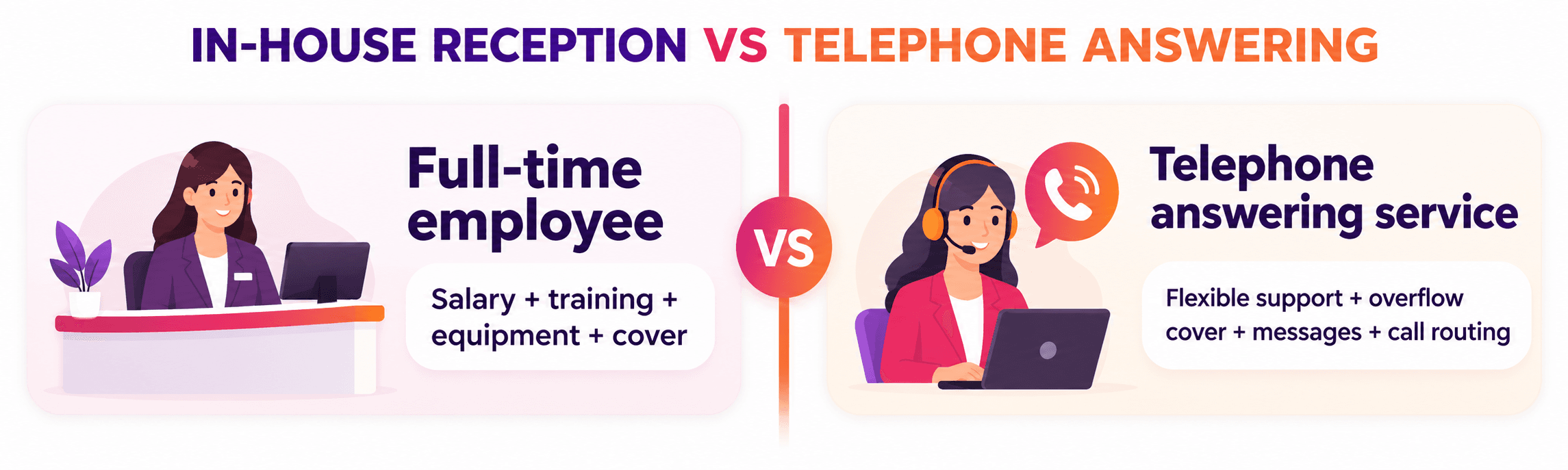
The cost of an employee is not limited to salary. Businesses may also need to consider recruitment, training, equipment, management time and holiday or absence cover.
Outsourced telephone answering offers a more flexible alternative.
You could use the service throughout the working day or only when:
Everyone is busy
Employees are in meetings
The office is closed
Team members are on holiday
Call volumes increase
Nobody answers after a certain number of rings
This flexibility makes telephone answering particularly useful during periods of growth.
Businesses can increase or reduce the level of support as their requirements change instead of adding permanent staffing costs before they are ready.
Respond faster and capture better information
Customers generally want to know that their enquiry has been received.
Even when the receptionist cannot solve the problem immediately, they can gather useful details and explain the next step.
For example:
Customer calls → Details collected → Message sent → Team member responds
The business receives more context than it would from a simple missed-call notification.
Some services can also ask predefined questions, such as:
What service are you interested in?
Where are you located?
When do you need the service?
What is the best number or email for a response?
Is the matter urgent?
For sales teams, this information can make follow-up more efficient.
Instead of returning every missed call without knowing what the person wants, the team can understand the enquiry before getting in touch.
This becomes increasingly useful as a company grows its network. Founders looking to exchange ideas and connect with other business owners can also use the Start My Business business community.
Handle busy periods and out-of-hours enquiries
Telephone demand is rarely consistent.
A campaign might suddenly generate more leads. A seasonal business could experience a sharp increase in enquiries. Several team members might be away at the same time.
An answering service can act as overflow support.
Your team answers calls when available, while additional calls are routed elsewhere when nobody can respond quickly enough.
Some providers also offer evening, weekend or 24-hour coverage.
This can be valuable when customers contact your business outside its normal working hours, particularly if your website and marketing continue generating enquiries around the clock.
Not every company needs 24/7 telephone support. The right level of coverage depends on customer behaviour, the importance of each enquiry and how quickly callers genuinely need a response.
Appointment booking can remove another layer of admin
For many service businesses, a large percentage of incoming calls relate to appointments.
Customers may call to ask about availability, rearrange a booking or schedule an initial consultation.
Some telephone answering services can integrate with booking systems or calendars, allowing the receptionist to arrange appointments using predefined availability.
The process becomes:
Customer calls → Availability checked → Appointment booked → Confirmation provided
This can work particularly well for consultants, accountants, tradespeople, coaches, agencies and other appointment-based businesses.
Instead of repeatedly checking diaries and returning calls, employees can spend more time on the work customers are actually paying them to do.
Telephone answering service or voicemail?
Voicemail remains perfectly suitable for some businesses.
The decision depends mainly on the importance and volume of incoming calls.
Telephone answering service | Voicemail |
Caller speaks with a person | Caller records a message |
Details can be collected immediately | Caller decides what information to leave |
Selected calls may be transferred | Requires later follow-up |
Basic questions may be answered | No real-time response |
Appointments may be arranged | Usually no booking support |
Provides a receptionist-style experience | Provides an automated experience |
A freelancer receiving only occasional calls may find voicemail sufficient.
A company generating regular telephone leads may benefit more from live answering because the business has more to lose when callers give up.
The key is to choose a solution based on how customers actually communicate with your company rather than paying for features you do not need.
How to choose the right telephone answering service
Before comparing providers, look at your current call activity.
Consider when calls arrive, why customers contact you and what information your team normally needs.
Then compare services based on a few practical factors.
Coverage: Decide whether you need full working-day support, overflow calls, evening coverage or round-the-clock answering.
Custom scripts: The receptionist should be able to use an appropriate greeting and follow instructions that reflect your business.
Message delivery: Check whether messages can be sent through email, SMS, an app or another system your team already uses.
Call transfers: Decide which types of enquiries should reach you immediately and which can wait.
Appointment booking: Businesses that rely heavily on appointments should check whether their preferred calendar or booking system is supported.
Pricing: Understand whether the service charges per call, per minute, through monthly allowances or using another model.
Scalability: Choose a service that can accommodate increased call volumes if your company grows.
You may also find new operational ideas through relevant Start My Business startup events and business perks available to founders.
When does your business need telephone answering support?
A telephone answering service becomes worth considering when missed calls start creating a noticeable operational problem.
Common signs include:
Customers regularly reaching voicemail
Leads calling while you are with other customers
Employees frequently being interrupted
Marketing campaigns increasing telephone enquiries
Customers calling outside normal hours
Remote employees struggling to manage one central number
Your company needing reception cover during holidays
Hiring a receptionist not yet making financial sense
You do not need to wait until every employee feels overwhelmed.
If telephone calls are important to your sales or customer service process, putting a reliable system in place early can prevent missed enquiries from becoming a recurring problem.
Keep call handling simple
A telephone answering service should reduce complexity rather than add another process for your team to manage.
Start with three questions:
Which calls need immediate attention?
What information should be collected from every caller?
How should messages reach your team?
From there, you can create a straightforward process:
Customer calls → Enquiry captured → Information routed → Team responds
As call volumes grow, you can introduce more advanced options such as lead qualification, appointment scheduling or extended-hours coverage.
Final thoughts
Small business owners cannot be available every minute of every working day.
Meetings, customer work, travel and focused tasks all create periods when answering the phone is difficult.
A telephone answering service provides a practical way to stay accessible without allowing every incoming call to interrupt your work.
For the right business, it can help capture more enquiries, create a professional first impression, improve response times and provide additional support as call volumes increase.
The goal is not simply to answer more calls. It is to make sure valuable customer conversations reach your business while giving you more time to focus on running it.
Julia Richards
Our Entrepreneurship Advisor and Head of Content, Julia has spent the past 20 years assisting entrepreneurs with all aspects of business launch and growth strategies in various industries around the globe.
Build a business that looks professional from day one
From company formation to practical tools for running your business, Start My Business brings useful startup resources together in one place.
Start building your businessQuestions?
What is a telephone answering service?
Is a telephone answering service suitable for small businesses?
Can answering services take calls outside normal working hours?
Can a virtual receptionist book appointments?
How is a telephone answering service different from voicemail?
Content Table
- 1. What is a telephone answering service?
- 2. Missed calls can cost more than you think
- 3. Professional call handling creates a stronger first impression
- 4. Protect your time without ignoring customers
- 5. Get reception support without hiring too early
- 6. Respond faster and capture better information
- 7. Handle busy periods and out-of-hours enquiries
- 8. Appointment booking can remove another layer of admin
- 9. Telephone answering service or voicemail?
- 10. How to choose the right telephone answering service
- 11. When does your business need telephone answering support?
- 12. Keep call handling simple
- 13. Final thoughts
Latest Blogs
 Legal Assistance
9 min
How to Choose a Business Name for Your LLC
 Legal Assistance
8 min
How to Start an LLC: Complete Step-by-Step Guide
Working out how to start an LLC begins with choosing the right state and un...
 Legal Assistance
8 min
LLC vs Partnership: Which is Better for Small Business?
The LLC vs partnership decision affects how you share ownership, manage dec...
 Compliance
7 min
LLC vs S-Corp Tax and Liability Comparison
Choosing between an LLC and an S corporation is often framed as a straight ...