



Registering a UK limited company now starts at £100 if you use Companies Ho...

 Blogs
 Filters
Back to Blogs

How to Form a US LLC as a Non-Resident - Complete 2026 Guide
Compliance
Aug 31, 2026
11 min
Forming a Limited Liability Company (LLC) in the United States is not limited to US citizens or residents. Foreign entrepreneurs can establish and own US LLCs without moving to the country, making company formation accessible to international founders who want to operate in or access the US market. If you want to form a US LLC as a non-resident, however, incorporation is only one part of the process.
You also need to consider where to register the company, appoint a registered agent, obtain an Employer Identification Number (EIN), understand federal and state tax obligations, and maintain the company correctly after formation. This guide explains the key steps and considerations for establishing a US LLC as a non-resident in 2026.
What Is a US LLC?
A Limited Liability Company is a business entity established under the law of a US state. One of its main features is the separation it can provide between the business and its owners, known as members. LLCs are popular because they can combine limited liability with relatively flexible management and federal tax treatment.
For federal income tax purposes, the IRS generally treats a domestic single-member LLC as a disregarded entity unless it elects corporate taxation. A domestic LLC with two or more members is generally treated as a partnership unless it elects to be taxed as a corporation.
The tax position of a foreign-owned LLC can nevertheless be more complicated than the formation itself, so the structure should be considered in the context of the owner's circumstances and business activities.
Can a Non-US Resident Form an LLC?
Yes. US citizenship or permanent residence is not generally required simply to own a US LLC. This makes LLCs accessible to entrepreneurs based outside the United States who want to establish a US business entity.
However, forming an LLC does not automatically
give you the right to live or work in the United States;
eliminate US tax or reporting requirements;
guarantee that a bank or payment provider will approve your application; or
mean that your business only has obligations in the state where it was formed.
Your immigration, tax, banking and company-law positions should therefore be considered separately.
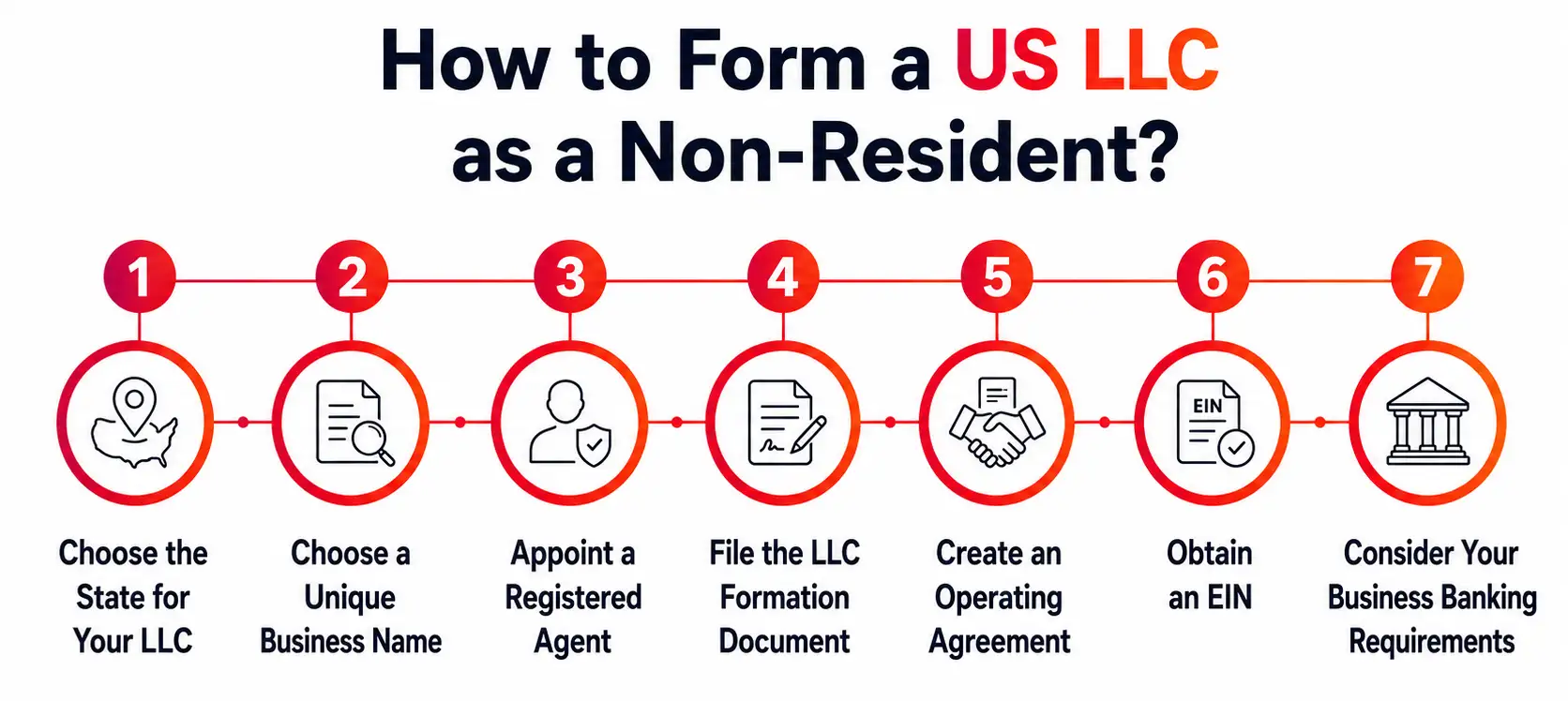
How to Form a US LLC as a Non-Resident?
The precise process varies by state, but the main stages are broadly similar.
1. Choose the State for Your LLC
LLCs are formed at state rather than federal level, so one of your first decisions is where to establish the business. States frequently considered by international founders include
Delaware
Wyoming
Florida
Texas
New York
There is no single "best" state for a non-resident LLC. If your business operates in a particular state, forming there may simplify compliance. Operating in another state may require foreign qualification in that state.
2. Choose a Unique Business Name
Your LLC needs a name that complies with the rules of the state where it is formed. Typically, the name must
be distinguishable from existing registered businesses;
contain "Limited Liability Company", "LLC" or another permitted abbreviation; and
avoid restricted terminology unless the necessary approval has been obtained.
A state business-name search should be completed before filing. It is also sensible to check domain names and trademarks. State approval of an LLC name does not necessarily give you trademark rights over that name.
3. Appoint a Registered Agent
An LLC generally needs a registered agent in its state of formation. The registered agent receives official correspondence, legal notices and service of process on behalf of the business. According to the US Small Business Administration, the agent must be located in the state where the business is registered. For non-resident founders without a physical presence in the state, using a professional registered-agent service is common.
4. File the LLC Formation Document
Next, you need to file the required formation document with the relevant state authority, usually the Secretary of State or equivalent agency. Depending on the state, this may be called
Articles of Organization;
Certificate of Formation; or
Certificate of Organization.
Information requested can include the LLC's name, registered agent, principal address and details relating to its management. You will also need to pay the applicable state filing fee. State fees vary. For example, Wyoming law specifies a $100 filing fee for original LLC Articles of Organization.
5. Create an Operating Agreement
An operating agreement establishes how the LLC will operate internally. Depending on the circumstances, it can cover
ownership percentages;
member contributions;
management responsibilities;
voting rights;
distributions;
admission or departure of members; and
procedures for closing the business.
Not every state requires an operating agreement to be filed with the government but having appropriate legal business documents can be particularly valuable for documenting ownership and governance. For a multi-member LLC, it can also reduce uncertainty or disputes between members.
6. Obtain an EIN
An Employer Identification Number is a federal tax identification number issued by the IRS. Despite its name, an EIN can be necessary even if the LLC has no employees. It may be required for federal tax filings and is commonly requested when dealing with banks and other financial institutions. Non-resident founders should not assume that they must have an SSN before an EIN can be obtained. IRS instructions provide procedures for applicants that do not have an SSN or ITIN, depending on the circumstances. The EIN application is made using Form SS-4.
7. Consider Your Business Banking Requirements
After forming the LLC and obtaining an EIN, you may want to establish a business bank account. Requirements differ between financial institutions, but you may be asked for documents such as:
LLC formation documents;
EIN confirmation;
operating agreement;
passport or other identification;
proof of address; and
information about the company's owners and activities.
Some providers may require additional verification or an in-person visit. Opening an LLC does not guarantee approval for a US bank account. Banks and financial institutions carry out their own compliance and Know Your Customer checks.
How Are Foreign-Owned US LLCs Taxed?
Tax is one of the areas where non-resident owners need to be particularly careful. Simply forming an LLC does not mean that all of its income is automatically subject to US federal income tax, nor does it mean that a foreign owner has no US tax obligations.
The outcome depends on factors including
the LLC's federal tax classification;
the number and residence of its members;
where services are performed;
whether the owner is engaged in a US trade or business;
whether income is US-source;
state tax rules; and
any applicable tax treaty.
The IRS states that a nonresident alien engaged in a US trade or business is generally taxed on effectively connected income after allowable deductions. Certain US-source income that is not effectively connected may instead be subject to a 30% tax or a lower applicable treaty rate. Because international tax rules are fact-specific, professional advice can be particularly important before conducting transactions through the LLC.
Form 5472 Requirements for Foreign-Owned Single-Member LLCs
A commonly overlooked requirement involves foreign-owned US disregarded entities. A foreign-owned US single-member LLC treated as a disregarded entity may have a Form 5472 filing obligation when it has reportable transactions with its foreign owner or other related parties. The IRS requires a foreign-owned US disregarded entity subject to these rules to file a pro forma Form 1120 with Form 5472 attached.
Transactions with an owner can include more than ordinary sales or purchases, so even seemingly simple movements of money between an owner and the LLC can require careful consideration. This is one reason foreign founders should not assume that having no US income tax due means there are no federal filing requirements.
Do US LLCs Need to File a BOI Report in 2026?
This area has changed significantly. As of August 2026, companies created in the United States, including US LLCs, are exempt from the federal Beneficial Ownership Information reporting requirements under the Corporate Transparency Act.
FinCEN issued its final rule on August 11, 2026, and it became effective on August 14, 2026. Under the final rule, US-created companies are not required to submit BOI reports to FinCEN. This should not be confused with a foreign company formed outside the United States and subsequently registered to do business in a US jurisdiction. Certain foreign entities remain subject to BOI reporting rules.
What Does It Cost to Form a US LLC as a Non-Resident?
There is no single nationwide LLC formation price. Your overall cost can include
state formation fee
registered-agent fee
professional formation assistance
annual report or state tax
accounting and tax preparation
licences and permits
foreign qualification fees where applicable
For example, Wyoming charges $100 to file original Articles of Organization and imposes an annual licence tax with a minimum of $60. Delaware domestic LLCs are subject to a $300 annual tax and do not file an annual report.
Ongoing Compliance After Forming Your LLC
Your responsibilities do not end when the formation document is approved. Depending on the state and the company's circumstances, ongoing requirements may include
maintaining a registered agent
filing state annual or periodic reports
paying annual state fees or taxes
maintaining business records
renewing licences and permits
filing applicable accounting and tax requirements
filing Form 5472 and a pro forma Form 1120 where required
registering in additional states if the business expands there
Missing tax or state filing requirements can result in penalties and may eventually affect the LLC's good standing. A compliance calendar can help international owners keep track of deadlines across different authorities.
Conclusion
Learning how to form a US LLC as a non-resident involves more than submitting formation documents to a state. You need to select an appropriate state, appoint a registered agent, complete the state filing, obtain an EIN and establish suitable banking and compliance arrangements.
Foreign owners also need to pay particular attention to US tax rules and information-reporting requirements such as Form 5472. Taking these factors into account from the beginning can help you establish a structure that supports your business while avoiding unnecessary compliance issues later. With the right preparation and business support, you can establish your US LLC correctly and manage your ongoing obligations more effectively.
Julia Richards
Our Entrepreneurship Advisor and Head of Content, Julia has spent the past 20 years assisting entrepreneurs with all aspects of business launch and growth strategies in various industries around the globe.
Start Your US Business with Start My Business
Get expert support with forming your US company as a non-resident. We’ll help you navigate the key formation requirements and simplify the setup process.
Start Your US CompanyQuestions?
Can a non-US citizen own 100% of a US LLC?
Do I need an SSN to form a US LLC?
What is the best state to form an LLC as a non-resident?
Does a foreign-owned US LLC have to pay US tax?
Does a US LLC need to file a BOI report in 2026?
Content Table
- 1. What Is a US LLC?
- 2. Can a Non-US Resident Form an LLC?
- 3. How to Form a US LLC as a Non-Resident?
- 4. How Are Foreign-Owned US LLCs Taxed?
- 5. Form 5472 Requirements for Foreign-Owned Single-Member LLCs
- 6. Do US LLCs Need to File a BOI Report in 2026?
- 7. What Does It Cost to Form a US LLC as a Non-Resident?
- 8. Ongoing Compliance After Forming Your LLC
- 9. Conclusion
Latest Blogs
 Compliance
7 min
Company Registration Costs in the UK: Full 2026 Breakdown
 Operations
9 min
Why Your Small Business Needs a Telephone Answering Service
Running a small business often means switching between customers, sales, ad...
 Legal Assistance
7 min
Company Formation in Dubai: Free Zone vs Mainland Setup Guide 2026
Dubai is one of the world’s most popular locations for international busine...
 Legal Assistance
9 min
How to Register for VAT in the UK: 2026 Guide for Small Businesses & Startups
For a growing UK business, VAT registration is one of those milestones that...