


Understanding how to choose LLC name ideas means balancing a memorable bran...

 Blogs
 Filters
Back to Blogs

Company Registration Costs in the UK: Full 2026 Breakdown
Compliance
Oct 7, 2026
7 min
Registering a UK limited company now starts at £100 if you use Companies House’s standard online service. That is the statutory entry price, not necessarily the full amount you will spend getting ready to trade. Your real budget may also include an address service, professional formation help, banking, insurance, accounting tools and sector-specific permissions.
This guide separates compulsory registraThe filing fee covers incorporation, not a complete launch
The £100 online fee creates the legal entity and provides a certificate of incorporation. You still need a compliant company name, a registered office, a registered email address, director and shareholder details, a statement of capital, people-with-significant-control information and articles of association. Before registration, directors may need to complete Companies House identity verification and provide their personal codes.
A standard online application can be economical when the ownership is simple and model articles suit the company. Professional input becomes more valuable when there are several founders, bespoke voting or share rights, overseas participants, investment plans or uncertainty about the most suitable structure. The cost is then partly payment for reducing the risk of correcting an unsuitable setup.
Privacy and address choices can change the starting budget
Every company needs an appropriate UK registered office address in the same UK jurisdiction in which it is registered. The address appears on the public register. If you use your home, that creates a privacy trade-off; if you use an accountant, solicitor or address provider, you need permission and the service must meet Companies House rules.
Registered-office and director service-address prices vary by location, mail handling and contract length, so obtain a current quote rather than relying on an industry average. Check whether scanning, forwarding, renewal and cancellation are included. A low introductory price can be poor value if essential mail handling becomes an add-on.tion fees from optional and ongoing costs. It reflects Companies House fees in force from 1 February 2026 and other official charges available on 7 October 2026, so you can decide what to pay for now, what can wait and where a cheap setup may create avoidable work later.
The minimum registration cost is £100 online
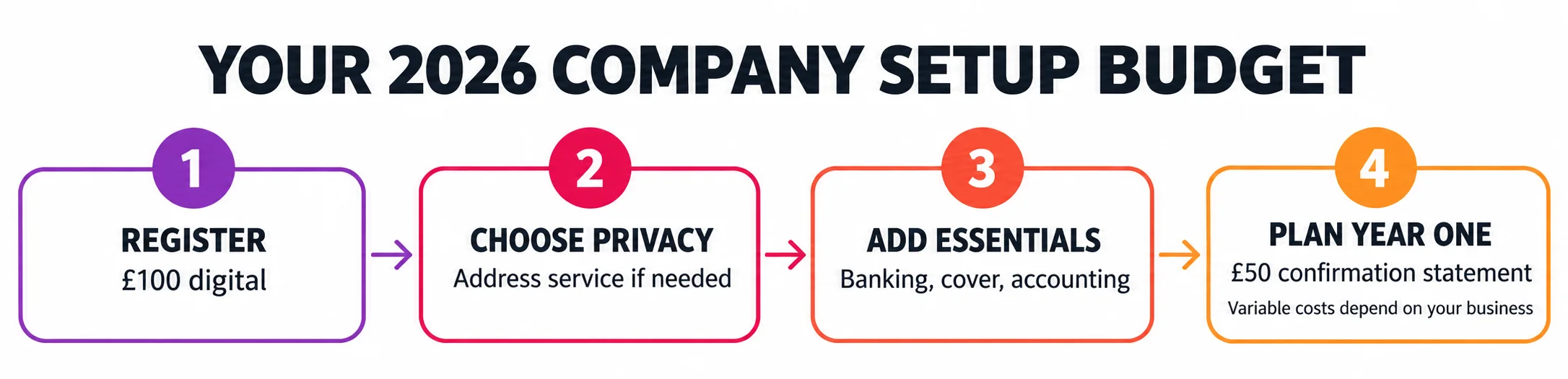
For a straightforward private company limited by shares using model articles, the Companies House online service costs £100. Companies House says most online applications are registered within 24 hours. A postal application costs £124 and normally takes 8 to 10 days. Same-day incorporation costs £156 and is available through software filing rather than the standard online route.
These are filing fees paid to Companies House. If you use a formation agent or another service provider, check whether its displayed price includes the Companies House fee, adds it at checkout or offsets it through a partner offer. Compare the final payable amount and the services you actually need, not the headline price alone.
Registration route | 2026 fee | Typical timing | Best fit |
Online | £100 | Usually within 24 hours | Most standard private limited companies |
Paper form IN01 | £124 | Usually 8 to 10 days | Applications that cannot use the online route |
Same-day software filing | £156 | Same day when conditions are met | Time-critical formations filed through software |
Community interest company | £115 online; £139 paper | Route dependent | Social enterprises using the CIC structure |
The filing fee covers incorporation, not a complete launch
The £100 online fee creates the legal entity and provides a certificate of incorporation. You still need a compliant company name, a registered office, a registered email address, director and shareholder details, a statement of capital, people-with-significant-control information and articles of association. Before registration, directors may need to complete Companies House identity verification and provide their personal codes.
A standard online application can be economical when the ownership is simple and model articles suit the company. Professional input becomes more valuable when there are several founders, bespoke voting or share rights, overseas participants, investment plans or uncertainty about the most suitable structure. The cost is then partly payment for reducing the risk of correcting an unsuitable setup.
Privacy and address choices can change the starting budget
Every company needs an appropriate UK registered office address in the same UK jurisdiction in which it is registered. The address appears on the public register. If you use your home, that creates a privacy trade-off; if you use an accountant, solicitor or address provider, you need permission and the service must meet Companies House rules.
Registered-office and director service-address prices vary by location, mail handling and contract length, so obtain a current quote rather than relying on an industry average. Check whether scanning, forwarding, renewal and cancellation are included. A low introductory price can be poor value if essential mail handling becomes an add-on.
Optional services should solve a specific startup problem
Formation agents can prepare and submit the application, explain package choices and sometimes bundle addresses or document storage. Their service fee is separate from, or inclusive of, the government fee depending on the offer. Confirm the company will be formed in your name with the intended shareholders, officers and share structure, and identify any annual renewals before buying.
Business banking may be free, subscription-based or charged by transaction. A domain, professional email and basic website also vary widely in price. Treat them as launch infrastructure rather than registration charges. The same applies to accounting software and professional advice: simple records may need a modest tool, while payroll, VAT, inventory, overseas sales or outside investment can justify more support.
Insurance depends on what the company does, where it operates and whether it employs anyone. Employers’ liability cover is generally compulsory when you become an employer, subject to exemptions, but the premium is market-priced. Regulated activities, licences and sector registrations can add further costs. Check the rules for your exact activity before trading rather than assuming incorporation grants permission to operate.
First-year compliance adds fixed and conditional costs
A limited company must file at least one confirmation statement every 12 months. The first statement filed in each 12-month payment period costs £50 digitally or £110 on paper. Think of that as the clearest recurring Companies House cash cost after incorporation, separate from the work involved in maintaining accurate records and filing accounts and tax returns.
Accounting costs are variable because activity matters more than incorporation itself. A dormant company, a one-person consultancy and a VAT-registered employer have different record-keeping and filing needs. Ask for a quote that states whether bookkeeping, payroll, VAT returns, statutory accounts, the Company Tax Return and director tax work are included.
Some companies that process personal data must also pay the ICO data protection fee unless exempt. GOV.UK states that most organisations pay £52 or £78 a year, with the band based on size and turnover. Use the official checker rather than assuming registration automatically creates a liability.
Trade mark registration is optional and different from registering a company name. From 1 April 2026, a standard online UK trade mark application costs £205 for one class, plus £60 for each additional class. Consider it where protecting a distinctive brand matters, but search existing marks and select classes carefully before spending.
A sensible budget starts with three totals
Write down three figures: the incorporation fee, the setup services needed before trading, and the first 12 months of compliance. For a simple DIY company using a suitable home or existing business address, the fixed Companies House cash cost can begin at £100, with £50 due for the first digital confirmation statement in the relevant payment period. That does not make the total first-year cost £150; it means £150 is the identifiable Companies House component before conditional and commercial expenses.
Then test each extra against a concrete need. Pay for privacy if you do not want a home address public. Pay for advice when ownership or tax decisions carry consequences. Pay for software when it saves reliable time. Keep a renewal list with dates and prices so introductory offers do not quietly become an unplanned annual burden.
Budget beyond the incorporation screen
The official price to register a standard UK limited company online is £100 in 2026. For most founders, the better planning number is the government fee plus the privacy, professional and operating services the business genuinely requires, followed by recurring compliance costs. Separate those categories, verify what packages include and choose a structure you can run properly from day one.
Julia Richards
Our Entrepreneurship Advisor and Head of Content, Julia has spent the past 20 years assisting entrepreneurs with all aspects of business launch and growth strategies in various industries around the globe.
Build only the support stack you need
Start My Business can help you map the services that fit your launch, from brand and digital setup to operational and professional support, without treating every add-on as compulsory.
Build Your Support PlanQuestions?
How much does it cost to register a company in the UK in 2026?
Is the Companies House fee the full cost of setting up a limited company?
Do I need to pay for a registered office address?
What does a limited company cost each year after registration?
Is registering a company name the same as registering a trade mark?
Content Table
- 1. Privacy and address choices can change the starting budget
- 2. The minimum registration cost is £100 online
- 3. The filing fee covers incorporation, not a complete launch
- 4. Privacy and address choices can change the starting budget
- 5. Optional services should solve a specific startup problem
- 6. First-year compliance adds fixed and conditional costs
- 7. A sensible budget starts with three totals
- 8. Budget beyond the incorporation screen
Latest Blogs
 Legal Assistance
9 min
How to Choose a Business Name for Your LLC
 Legal Assistance
8 min
How to Start an LLC: Complete Step-by-Step Guide
Working out how to start an LLC begins with choosing the right state and un...
 Legal Assistance
8 min
LLC vs Partnership: Which is Better for Small Business?
The LLC vs partnership decision affects how you share ownership, manage dec...
 Compliance
7 min
LLC vs S-Corp Tax and Liability Comparison
Choosing between an LLC and an S corporation is often framed as a straight ...