


Registering a UK limited company now starts at £100 if you use Companies Ho...

 Blogs
 Filters
Back to Blogs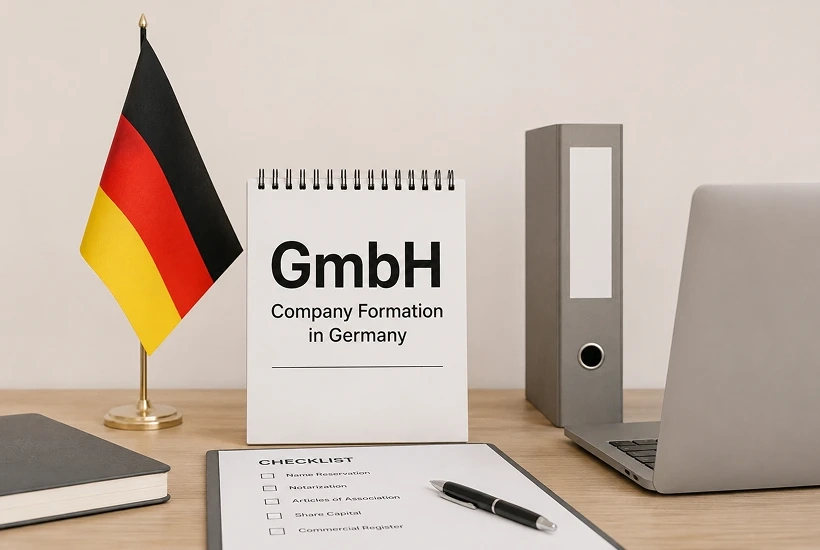

Company Formation in Germany (GmbH): Step-by-Step Guide for Foreigners
Compliance
Sep 8, 2026
11 min
Germany is one of Europe’s most attractive markets for founders who want credibility, access to the EU single market, and a corporate structure that international customers already recognize. For many foreign entrepreneurs, the default choice is the Gesellschaft mit beschränkter Haftung, better known as a GmbH - Germany’s private limited liability company.
The important point is that you do not need to be German, or even live in Germany, to own a GmbH. Germany Trade & Invest confirms that the nationality and residence of shareholders and managing directors are generally irrelevant. What you do need is a German business address, a local representative, a notary-led formation process, sufficient share capital, and the registrations that follow incorporation.
If you are comparing jurisdictions before deciding where to incorporate, you may also want to review our US LLC guide for non-residents. The German route is more formal than forming a US LLC, but the trade-off is a well-established EU company form with strong recognition among banks, suppliers, and enterprise customers.
Can Foreigners Form and Own a GmbH in Germany?
Yes. A GmbH can have one or more shareholders, and they can be individuals or legal entities. Foreign ownership can be 100%. The managing director can also be a foreign national. There is no general rule requiring a German co-founder or German shareholder simply because the company is incorporated in Germany.
The practical requirements matter more than nationality. The company needs a registered office and business address in Germany, and trade registration requires a local representative. Foreign corporate shareholders should expect additional documentation proving the parent company’s existence and the authority of the people signing on its behalf. Depending on the country of origin, documents may need apostilles, legalization, certified translations, or other authentication.
Ownership and immigration are separate issues. You can own a GmbH from abroad without automatically receiving the right to live or work in Germany. If you plan to move to Germany and actively run the business there, non-EU/EEA founders may need a self-employment residence permit under the applicable immigration rules.
Why the GmbH Is the Standard Choice for Serious German Operations
The GmbH is popular because it separates the company’s liabilities from the shareholders’ personal assets, subject to the usual exceptions for misconduct, guarantees, or breaches of director duties. It also sends a clear signal that the business is established under German corporate law rather than operating informally from overseas.
For businesses selling to German enterprises, hiring locally, signing leases, or building a long-term European presence, that credibility can matter. A GmbH is also more flexible than many founders expect: a single shareholder is enough, ownership can be held by another company, and the articles of association can be tailored to governance, transfer restrictions, voting rights, and investor arrangements.
If your main goal is a lightweight international entity for payments or a digital business, a different jurisdiction may be simpler. Our guide to
explains that alternative. For a genuine German operating company, however, the GmbH is usually the more natural fit.
Step 1: Choose the Company Name, Purpose, Shareholders, and Managing Director
Start with the basic architecture of the company. The proposed name must be distinguishable and suitable for registration, and it must include the legal form “GmbH.” The business purpose should be specific enough for the Commercial Register and tax authorities to understand what the company will do without being so narrow that a small change in activities forces an amendment.
You also decide who owns the shares, the amount allocated to each shareholder, and who will act as managing director (Geschäftsführer). This is the point to think through decision-making and ownership properly, especially if there are multiple founders. Fixing a weak shareholder arrangement after incorporation is usually more expensive than getting it right at the start.
Step 2: Draft the Articles of Association and Gather Foreign Documents
The articles of association set out the company name, registered office, business purpose, share capital, and each shareholder’s participation. Straightforward cash formations with no more than three shareholders and one managing director may be able to use Germany’s statutory model protocol, which can reduce complexity and notarial cost. More sophisticated companies normally use bespoke articles.
Foreign founders should prepare passports, proof of address, and any documents requested for identity and beneficial-owner checks. If a foreign company will be a shareholder, the notary will usually need an up-to-date commercial register extract, constitutional documents, and evidence showing who can legally represent that parent company. Ask the notary about authentication requirements before arranging translations or couriering originals.
Step 3: Notarize the Formation
A German notary is central to GmbH formation. The shareholders execute the articles, the managing director is appointed, and the incorporation documents are notarized. Germany has expanded online notarial procedures, but whether a foreign founder can use them depends on the identity documents and electronic identification methods supported for the specific process.
For many non-resident founders, the safest approach is to check remote eligibility with the notary early. If online incorporation is not practical, the founder may attend in person or use a properly structured power of attorney where legally acceptable. The exact method should be confirmed with the notary handling the filing.
Step 4: Open the Company Bank Account and Pay the Share Capital
A standard GmbH has minimum share capital of EUR 25,000. For a normal cash formation, at least EUR 12,500 in total generally needs to be actually contributed and verifiable before the company is registered in the Commercial Register. The unpaid balance remains an obligation of the shareholders. Contributions in kind are possible, but they require extra documentation and valuation and are less suitable for a simple foreign-founder setup.
Bank onboarding is often the least predictable part of the timeline because the bank must complete KYC and beneficial-owner checks. Prepare the notarized documents, shareholder details, business model, expected transaction volumes, source-of-funds evidence, and ownership chart before applying. If you are building a cross-border finance stack, our
is useful background on the kind of documentation financial institutions commonly expect, although German GmbH banking requirements differ from US-company onboarding.
Step 5: Register the GmbH in the Commercial Register
After the required capital has been paid, the managing director applies for registration in the Handelsregister through the notary. The registry reviews the formation documents and, once the requirements are satisfied, enters the company. This is the key legal milestone: the GmbH becomes a registered legal entity and the intended limited-liability structure is fully in place.
Before registration, the company may operate as a GmbH in formation (GmbH i.G.), but founders should be careful about signing contracts or taking on liabilities during this stage. The protections and responsibilities before registration are not identical to those of the fully registered GmbH.
Step 6: Complete Trade Registration and Tax Registration
Commercial Register entry is not the end. Before normal operations begin, the company must notify the competent local trade office (Gewerbeamt or Ordnungsamt). Many ordinary businesses do not need a special operating license, but regulated sectors — such as certain financial, transport, hospitality, healthcare, or professional activities may need permits or approvals.
The company must also complete tax onboarding with the German tax authorities. A GmbH is subject to corporate income tax and trade tax, and VAT registration may be relevant depending on the activity and transactions. Germany’s nationwide corporate income tax is 15%, with a solidarity surcharge added to that tax, while trade tax varies by municipality. Germany Trade & Invest states that the average combined corporate tax burden is around 30%, although the actual rate depends on location and facts.
Step 7: Put Ongoing Accounting and Compliance in Place
A GmbH is not a “form it and forget it” company. It must maintain proper books and records, prepare annual financial statements, file tax returns, and meet publication or filing obligations that apply to its size and circumstances. Changes to directors, registered office, share capital, or other register information may require formal filings.
For foreign owners, the cleanest setup is to arrange bookkeeping, payroll if hiring, VAT support, and annual accounts from the beginning rather than reconstructing records at year-end. Also check whether your home country requires reporting of foreign company ownership, dividends, controlled foreign companies, or overseas assets.
How Long Does GmbH Formation Take?
There is no single guaranteed timeline. A straightforward case can move efficiently once the documents, notary appointment, bank account, and capital payment are coordinated, but foreign document verification and bank KYC can extend the process. A realistic planning approach is to treat the bank and any cross-border authentication as the likely bottlenecks rather than assuming the Commercial Register filing itself will be the slowest step.
If speed matters, choose the notary early, confirm exactly which foreign documents are required, check whether online notarization is available to you, and start bank onboarding as soon as the notarized formation documents allow it. Avoid relying on a fixed “two-week” promise unless the provider controls each dependency.
What Does It Cost to Form a GmbH?
The biggest number is the EUR 25,000 stated share capital, but share capital is not simply a government fee. At least EUR 12,500 is normally paid in before registration for a standard cash formation, and the company can generally use contributed capital for legitimate business expenses after formation, subject to capital-maintenance rules.
On top of capital, budget for notary and Commercial Register fees, translations or authentication of foreign documents, bank or payment costs, trade registration, tax and accounting support, and any permit required for your industry. Formation costs vary with the number of shareholders, the complexity of the articles, whether a foreign corporate shareholder is involved, and how much professional support you use.
GmbH vs. UG: Is the Lower-Capital Option Better?
Germany also offers the Unternehmergesellschaft (haftungsbeschränkt), commonly called a UG or “mini-GmbH.” It can be formed with share capital below EUR 25,000, but the capital must be fully paid in and the company must retain one quarter of annual profit until sufficient capital has accumulated. It follows broadly the same formation framework as a GmbH.
A UG can make sense when capital is the main constraint, but a GmbH often carries stronger market perception and avoids the need to explain the lower-capital status to counterparties. If you already expect significant contracts, employees, investors, or a German office, starting directly as a GmbH may be cleaner.
Final Takeaway
Foreigners can form and fully own a GmbH in Germany, and the process is manageable when handled in the right sequence. The essentials are a German business address and local representative, suitable formation documents, notarization, sufficient share capital, a bank account, Commercial Register entry, trade registration, tax onboarding, and ongoing accounting compliance.
Compared with simpler jurisdictions, Germany asks for more formalities upfront. For founders who genuinely need a German operating company, that formality is also part of the value: the GmbH is familiar to European customers, banks, suppliers, employees, and investors. Prepare the cross-border documents early, avoid treating immigration and ownership as the same issue, and build compliance into the company from day one.
Julia Richards
Our Entrepreneurship Advisor and Head of Content, Julia has spent the past 20 years assisting entrepreneurs with all aspects of business launch and growth strategies in various industries around the globe.
Build the German company around your real operating plan
The right structure depends on where management sits, who owns the shares, how capital is funded, and where customers and employees are located. Map those facts before filing.
Talk to a formation specialistQuestions?
Can a foreigner own 100% of a GmbH in Germany?
Do I need to live in Germany to be the managing director?
What is the minimum share capital for a GmbH?
Can I form a GmbH remotely?
Does a GmbH pay tax in Germany?
Content Table
- 1. Can Foreigners Form and Own a GmbH in Germany?
- 2. Why the GmbH Is the Standard Choice for Serious German Operations
- 3. Step 1: Choose the Company Name, Purpose, Shareholders, and Managing Director
- 4. Step 2: Draft the Articles of Association and Gather Foreign Documents
- 5. Step 3: Notarize the Formation
- 6. Step 4: Open the Company Bank Account and Pay the Share Capital
- 7. Step 5: Register the GmbH in the Commercial Register
- 8. Step 6: Complete Trade Registration and Tax Registration
- 9. Step 7: Put Ongoing Accounting and Compliance in Place
- 10. How Long Does GmbH Formation Take?
- 11. What Does It Cost to Form a GmbH?
- 12. GmbH vs. UG: Is the Lower-Capital Option Better?
- 13. Final Takeaway
Latest Blogs
 Compliance
7 min
Company Registration Costs in the UK: Full 2026 Breakdown
 Operations
9 min
Why Your Small Business Needs a Telephone Answering Service
Running a small business often means switching between customers, sales, ad...
 Legal Assistance
7 min
Company Formation in Dubai: Free Zone vs Mainland Setup Guide 2026
Dubai is one of the world’s most popular locations for international busine...
 Legal Assistance
9 min
How to Register for VAT in the UK: 2026 Guide for Small Businesses & Startups
For a growing UK business, VAT registration is one of those milestones that...