


Understanding how to choose LLC name ideas means balancing a memorable bran...

 Blogs
 Filters
Back to Blogs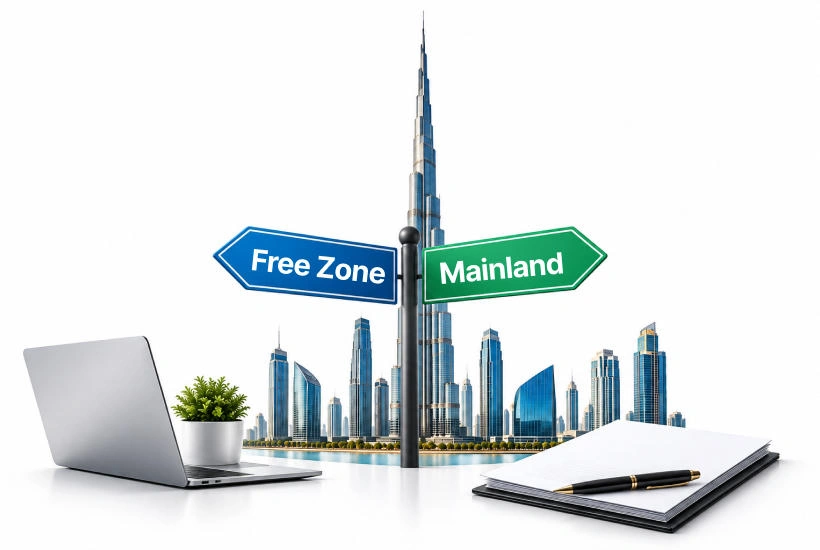

Company Formation in Dubai: Free Zone vs Mainland Setup Guide 2026
Legal Assistance
Sep 22, 2026
7 min
Dubai is one of the world’s most popular locations for international business, but the first decision can shape almost everything that follows: should you form a Free Zone company or a Mainland company?
Both routes can offer 100% foreign ownership for many activities and UAE residence visa options. The key differences are where you trade, who licenses you, what premises you need and how corporate tax applies.
Free Zone vs Mainland in Dubai: Quick Comparison
Factor | Dubai Free Zone | Dubai Mainland |
Licensing authority | Relevant Free Zone authority | Dubai Department of Economy and Tourism (DET) |
Foreign ownership | 100% in Free Zones | Up to 100% for most activities; strategic activities can have restrictions |
UAE mainland trading | Regulated; extra licence, branch or distributor route may be needed | Direct access across the UAE, subject to activity approvals |
Office options | Flexi-desk, co-working and zone-specific offices are common | Physical business address generally required; Dubai leases are commonly linked to Ejari |
Corporate tax | 0% only on qualifying income for a Qualifying Free Zone Person; 9% can apply to non-qualifying taxable income | Standard UAE corporate-tax rules generally apply |
Best suited to | International trade, digital services, exporters and sector clusters | UAE-facing services, retail, contracting, government work and onshore operations |
What Is a Dubai Free Zone Company?
A Free Zone company is incorporated inside one of Dubai’s designated economic zones. Dubai has more than 20 Free Zones, many focused on sectors such as commodities, technology, logistics, media, finance and professional services. Free Zones typically offer 100% foreign ownership, streamlined registration, specialised infrastructure and flexible workspace, making them attractive to overseas founders.
The main limitation is market access. Free Zone companies can trade internationally and within their permitted zone environment, but direct business on the UAE mainland is regulated. Depending on the activity, you may need a mainland branch, a separate mainland licence or a licensed distributor. Each Free Zone has its own fee schedule. DMCC lists 2026 entry packages from the mid-AED 30,000s, while other zones can cost less or more. Compare the full first-year cost, not an advertised “from” price.
What Is a Dubai Mainland Company?
A Mainland company is licensed by Dubai’s Department of Economy and Tourism. It can operate across Dubai and the wider UAE, subject to the activities on its licence and any sector-specific approvals. Mainland is usually the cleaner route when revenue will come from UAE consumers, local businesses, physical retail, onshore services or government work.
The ownership rules have changed significantly. The old blanket requirement for a 51% UAE shareholder no longer applies to most activities. Foreign investors can own many Mainland businesses 100%, although strategically important activities may still have special rules. Mainland companies also need an appropriate business address. Exact premises requirements depend on the activity and licence, so office costs can be a major part of the budget.
How to Choose Between Free Zone and Mainland
Start with where your customers are. Choose a Free Zone when most of your work is international, online or outside the UAE mainland; you value a packaged setup with flexible workspace; or a particular zone offers useful industry infrastructure.
Choose Mainland when you want to sell directly throughout the UAE, open customer-facing premises, tender for local or government contracts, build a larger onshore team or avoid adding a second licensing layer later. Plan for the next two years, not just today’s cheapest licence. A Free Zone setup can become costly if you later need a Mainland branch, while Mainland may be unnecessary for an overseas-focused remote business.
Dubai Company Formation Steps in 2026
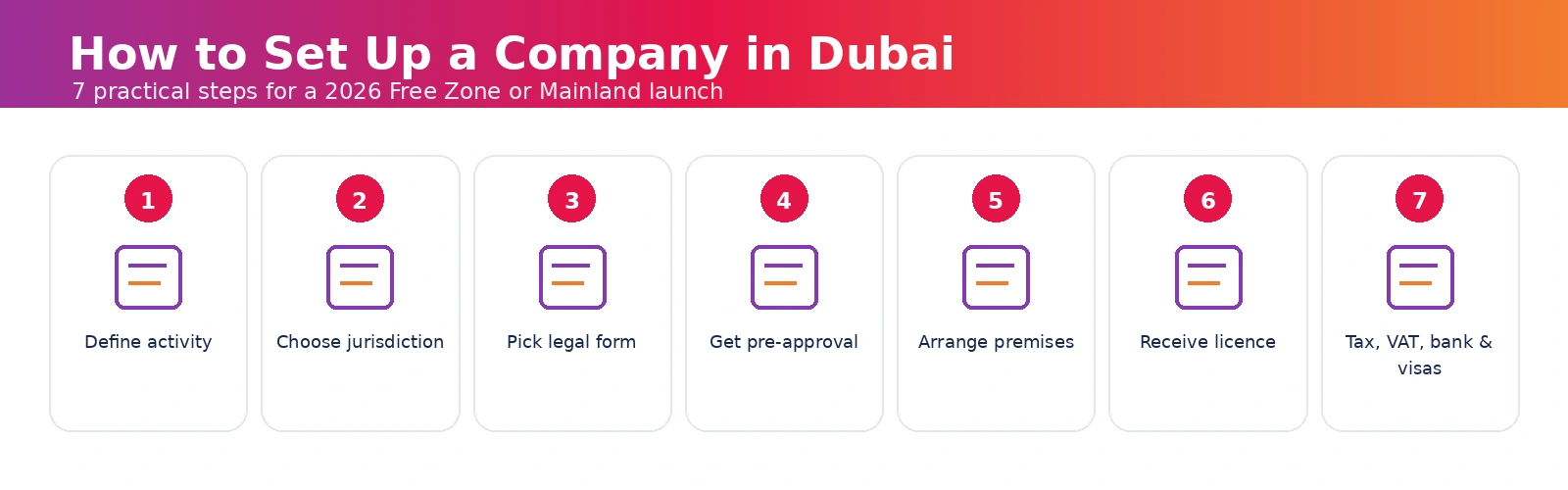
1. Define Your Business Activity
Your activity determines the licence type, legal form and approvals. Be precise about what you will actually sell.
2. Choose Free Zone or Mainland
Compare customer location, office needs, visa plans, tax treatment and future expansion rather than licence price alone.
3. Select the Legal Form and Trade Name
Typical structures include an LLC, Free Zone company, Free Zone establishment or branch. Reserve a compliant trade name.
4. Obtain Initial or Pre-Approval
Mainland applicants generally go through DET initial approval. Free Zone applicants follow the selected authority’s process. Regulated activities may require extra approvals.
5. Arrange Premises and Incorporation Documents
Prepare shareholder and manager documents, constitutional documents and the required lease, flexi-desk or office agreement. Mainland premises in Dubai are commonly tied to Ejari registration.
6. Pay Fees and Receive the Licence
Once documents and approvals are accepted, pay the authority’s registration and licensing charges. Your licence defines the activities you can legally conduct.
7. Complete Post-Licence Registrations
Open the corporate bank account, arrange immigration files and visas, and complete the required corporate tax and VAT registrations. A practical post-company formation checklist can keep each operational step organised after the licence is issued.
Corporate Tax and VAT in 2026
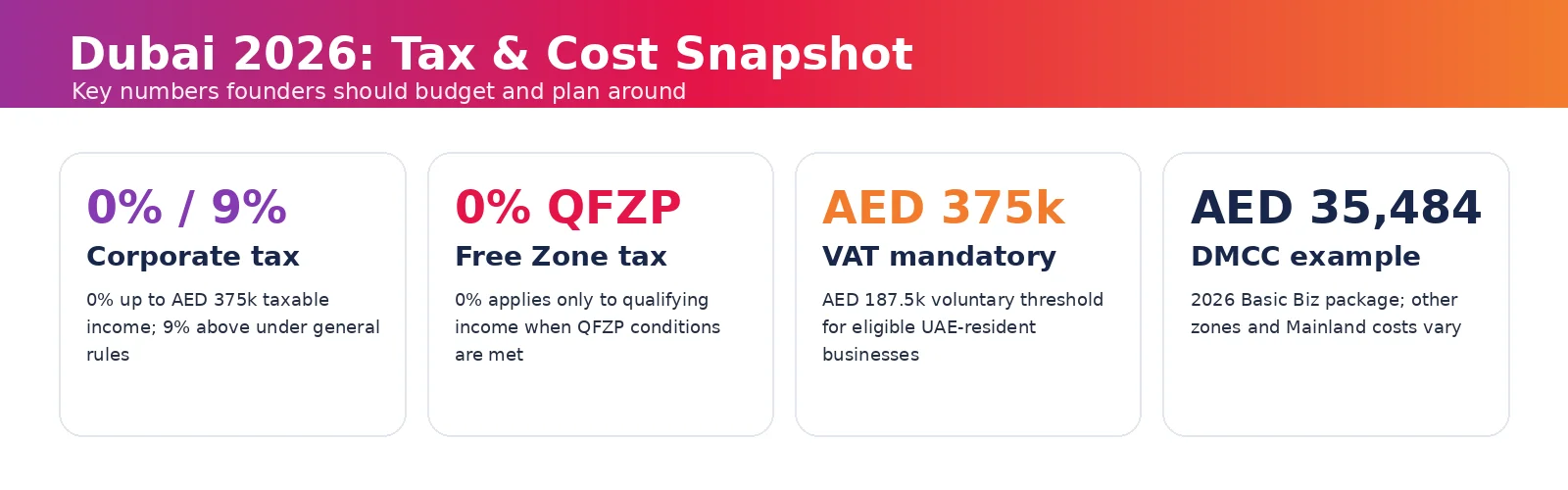
For ordinary taxable businesses, the general framework applies 0% corporate tax to taxable income up to AED 375,000 and 9% above that amount. Eligible resident businesses with revenue up to AED 3 million may be able to elect for Small Business Relief for qualifying periods ending on or before 31 December 2026.
A Qualifying Free Zone Person (QFZP) can benefit from 0% corporate tax on qualifying income, but only if the required conditions are met. Non-qualifying taxable income can be taxed at 9%. Free Zone status alone does not create a blanket exemption.
VAT is separate. UAE-resident businesses must register when taxable supplies and imports exceed AED 375,000 under the mandatory rules, while voluntary registration can be available above AED 187,500. These thresholds can apply to both Mainland and Free Zone businesses.
What Does Dubai Company Formation Cost in 2026?
There is no single Dubai setup price because the total depends on jurisdiction, activity, office, visas and approvals. For Free Zones, published packages vary widely. DMCC lists a Basic Biz package at AED 35,484 in 2026, with higher prices for larger workspace and service packages. Other zones may offer lower entry costs for limited activities and fewer visas.
Mainland costs can include trade-name reservation, approvals, licence issuance, incorporation documents, office rent, Ejari, immigration files and visas. Compare first-year all-in cost, not just the licence fee.
Final Thoughts
Free Zone and Mainland companies are both strong options in 2026; they solve different problems. Free Zones can provide efficient, internationally focused setups with flexible workspace and industry ecosystems. Mainland companies provide wider direct access to the UAE market and often suit businesses built around local customers, contracts and physical operations.
The smartest choice is the one that still works when the business grows. Compare customer geography, tax treatment, licensing scope, office needs, visa requirements and total first-year cost before you incorporate.
Julia Richards
Our Entrepreneurship Advisor and Head of Content, Julia has spent the past 20 years assisting entrepreneurs with all aspects of business launch and growth strategies in various industries around the globe.
Ready to form your Dubai company?
Specialist UAE company formation services can support structure selection, registration and post-incorporation compliance when you are ready to proceed.
Start your Dubai companyQuestions?
Can a foreigner own 100% of a Dubai company?
Is a Free Zone company tax-free in 2026?
Can a Free Zone company sell to Mainland customers?
Which setup is better for an online consultancy?
How long does Dubai company formation take?
Content Table
- 1. Free Zone vs Mainland in Dubai: Quick Comparison
- 2. What Is a Dubai Free Zone Company?
- 3. What Is a Dubai Mainland Company?
- 4. How to Choose Between Free Zone and Mainland
- 5. Dubai Company Formation Steps in 2026
- 6. Corporate Tax and VAT in 2026
- 7. What Does Dubai Company Formation Cost in 2026?
- 8. Final Thoughts
Latest Blogs
 Legal Assistance
9 min
How to Choose a Business Name for Your LLC
 Legal Assistance
8 min
How to Start an LLC: Complete Step-by-Step Guide
Working out how to start an LLC begins with choosing the right state and un...
 Legal Assistance
8 min
LLC vs Partnership: Which is Better for Small Business?
The LLC vs partnership decision affects how you share ownership, manage dec...
 Compliance
7 min
LLC vs S-Corp Tax and Liability Comparison
Choosing between an LLC and an S corporation is often framed as a straight ...